Progressive Overload: The Only Way To Actually Build Muscle
Here's a question most blokes never stop to ask themselves: why does our body build muscle in the first place?
Your body doesn't care about looking jacked. It doesn't care about filling out a t-shirt. It cares about one thing — survival. Your body is constantly trying to optimise itself to keep you alive. That's it.
When you step in the gym and do more work with a muscle than it's ever done before, your body thinks: "Right, that was hard. I'd better build a bit more muscle so I'm safe for that next time."
But here's where most blokes go wrong.
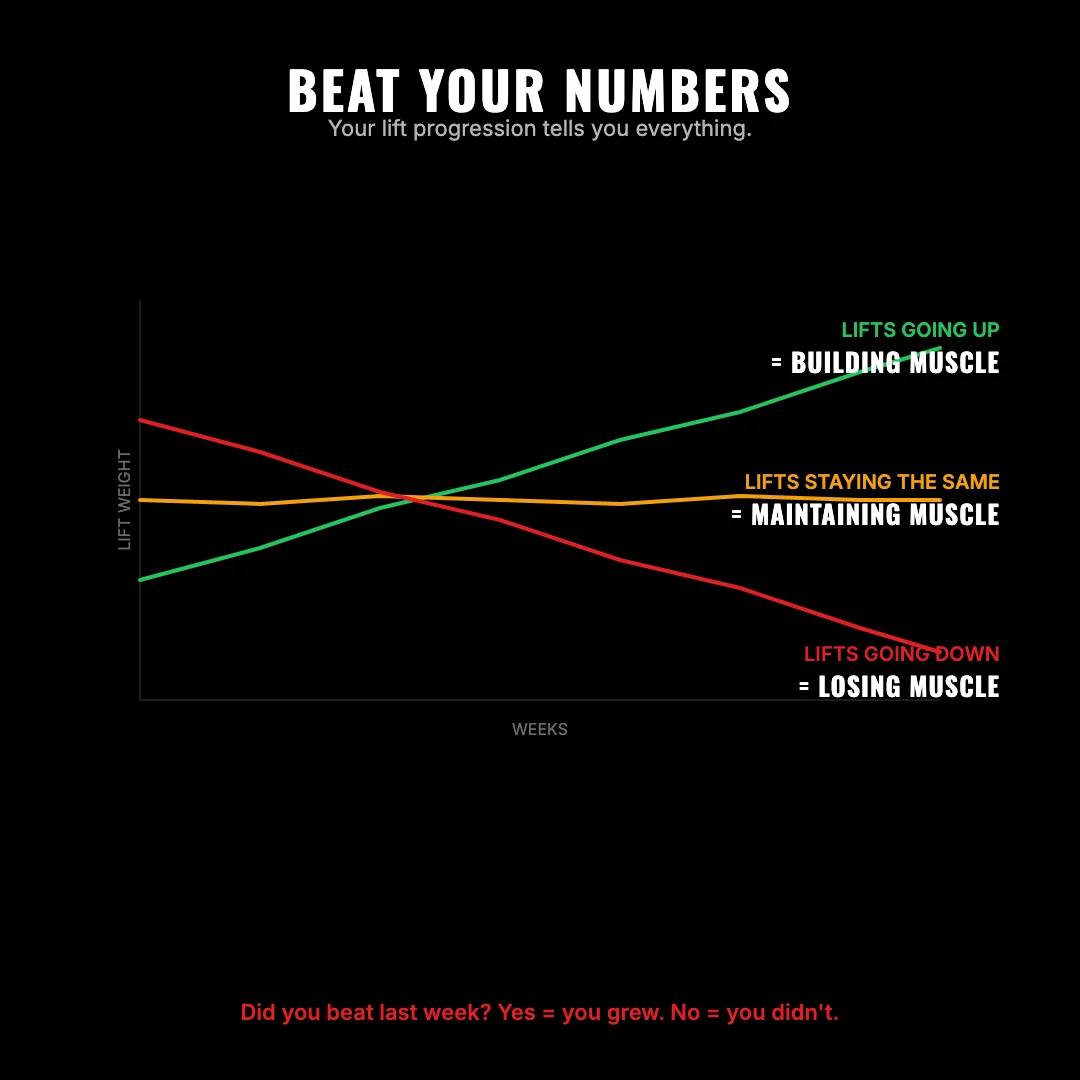
If Your Lifts Aren't Going Up, You're Not Growing
If you go into the gym this week and squat 100 kilos for 10 reps, your body is going to adapt. It's going to build some muscle to handle that.
Now, if you come in next week and squat 100 kilos for 10 reps again — do you think your body is going to build more muscle?
No. It's already safe for that. You're telling your body "we still need the muscle from last week" — but you're not telling it we need more.
The rule is dead simple:
- If your lifts are going up — you're building muscle
- If your lifts are staying the same — you're maintaining
- If your lifts are going down — you're losing muscle
This is progressive overload. It's the only mechanism that actually triggers muscle growth. Everything else — the pump, the soreness, the sweat — is just a side effect. If you're not doing more total work than last time, you're not growing. Full stop.
Why Most Blokes Train Hard And Still Look The Same
We see it all the time. Blokes come through the program and say "I train hard, I leave my soul in the gym, but I look the same as I did a year ago."
The reason? They're lifting the same weight, for the same reps, week after week. They feel like they're working hard — and they are — but their body has already adapted to that level of work.
Building muscle is an inefficient process for your body. Unless it genuinely believes it needs more muscle to survive, it's not going to waste energy building it.
You might even be training to failure and your lifts are going down. That means you're losing muscle — even though you're absolutely battering yourself every session.
How To Make It A Simple Yes Or No
When you structure your training properly, every single session becomes a yes or no question: did I beat my numbers?
- If yes — you grew
- If no — you didn't
It takes the emotion out of it completely. Doesn't matter if you've had a rubbish day at work. Doesn't matter if you're tired. You're in the gym, you know what numbers you need to beat, and you either beat them or you don't.
When you're at rep seven and you want to put the weight down, but you know you need nine — it's a lot easier to push through when you understand that those two extra reps are literally the difference between growing and wasting your time.
You Need To Log Your Lifts
If you know your numbers off the top of your head, you've been on those numbers for too long.
The stronger you get, the harder progression becomes. And unless you're writing down what you lifted last week, you will either maintain or go backwards. Guaranteed.
Even if you train hard. Even if you take every set to failure. Without tracking, you're guessing — and guessing doesn't build muscle.
What About When You're Cutting?
If you're in a fat loss phase, the goal shifts slightly. You're still pushing for progression where you can, but if you're deep into a cut — especially if you've already lost 15-20 kilos — it might be a fight just to hold your lifts.
And that's fine. Remember: if your lifts are staying the same, you're maintaining your muscle mass. In a cutting phase, that's a win.
But if you've just started the program — whether you're cutting or building — you're probably going to progress your lifts pretty fast regardless, because most blokes have never structured their training in a way that's set up for progression.
The Bottom Line
Stop training on feel. Start training on numbers.
- Log every set
- Beat your numbers every week
- Walk out of the gym knowing whether you grew or not
It's not complicated. It's just a system — and systems beat motivation every single time.
Sam Board
Founder & Head Coach at Built Body Transformations. 1,700+ clients coached.