Stop Shocking The Muscle — Why Mixing Your Workouts Is Killing Your Gains
One of the biggest myths in the gym — and I mean one that has been around for decades — is the idea that you need to constantly mix up your exercises to "shock the muscle" into growing.
You've heard it before. "Your body adapts, so you need to keep it guessing." Blokes change their entire program every week, swap exercises every session, do a completely different split every month — and they wonder why they still look the same.
If you've been asking yourself "should I mix up my workouts?" — the answer is almost certainly no. And I'm going to explain exactly why.
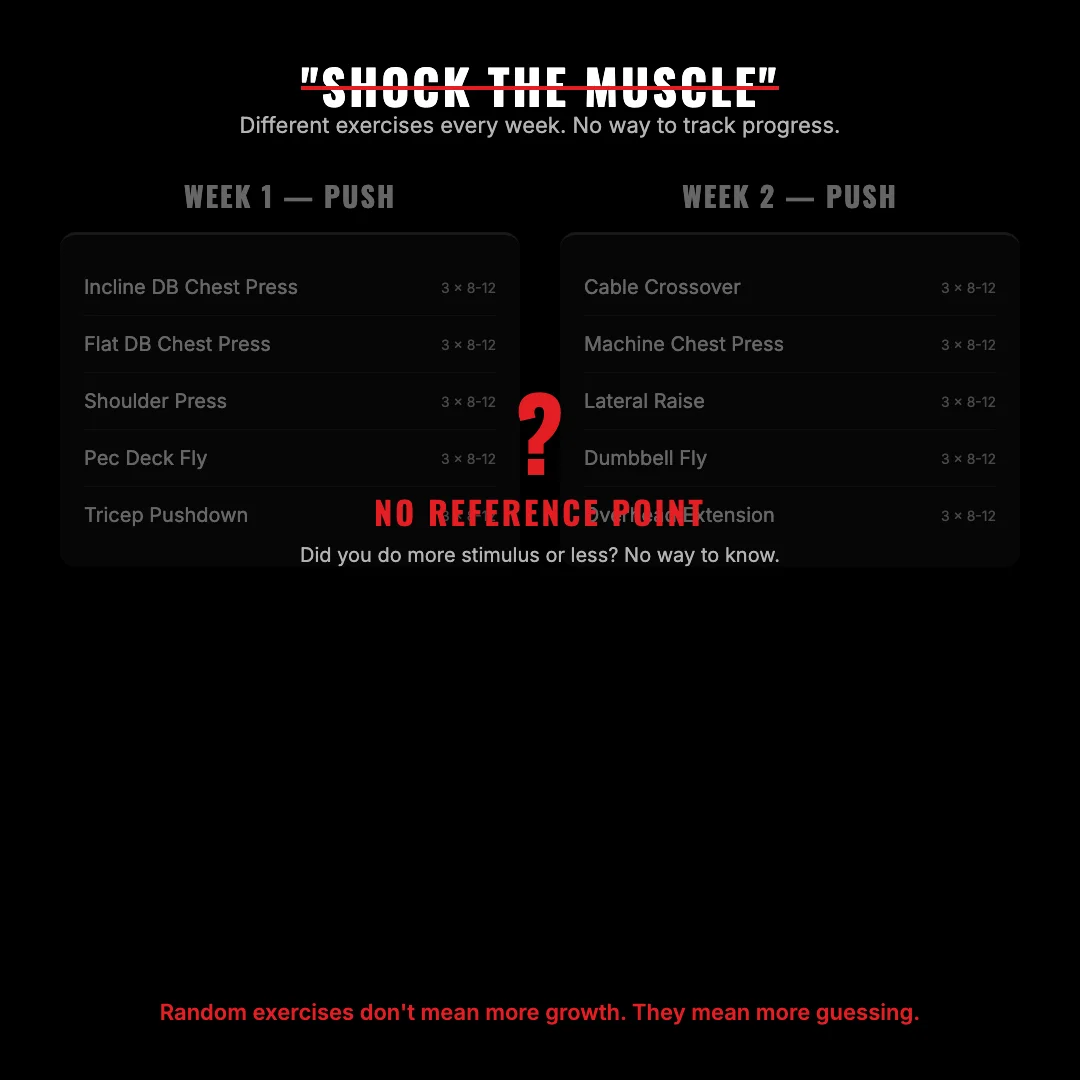
You're Throwing Shit At The Wall And Hoping Something Sticks
When you change your exercises every session, you have no reference point. None. You can't tell if you did more work than last week or less. You have no way of knowing.
Think about it. Last Monday you did flat dumbbell press for 4 sets of 10 with 30s. This Monday you did incline barbell press for 3 sets of 12 with 60 kilos. Did you do more total work? Less? The same?
You have absolutely no idea. Different exercises, different rep ranges, different equipment. You're comparing apples to oranges. And if you can't tell whether you did more or less work — you can't tell whether you're growing or not.
That's not training. That's throwing shit at the wall and hoping something sticks.
Different Exercises Doesn't Mean More Work
Here's what most blokes don't realise. Just because you did different exercises doesn't mean you did more total work. You could actually be doing less — and you'd never know.
You might feel like you worked hard. You got a pump. You're sore the next day. But soreness doesn't mean growth. Novelty doesn't mean progression. If you didn't do more measurable work than last time, your body has no reason to build more muscle.
And without keeping the exercises the same, you have no way to measure that.
Think Of It Like A Science Experiment
If you ran a science experiment and changed a million variables at once — the exercises, the order, the rep ranges, the rest times, the tempo — and then something changed, what would you know?
Nothing. You'd have no idea what caused the result. Was it the new exercise? The higher reps? The shorter rest? You'd be guessing.
Now flip it. Imagine you kept everything exactly the same — same exercises, same order, same sets, same rep ranges — and the only variable that changed was the reps or the weight.
Now you know exactly what happened. You did more work. Full stop. That's what drives growth.
The formula is simple: same exercises, same order, same sets, same rep ranges. The only thing that changes week to week is reps or weight. That's it.
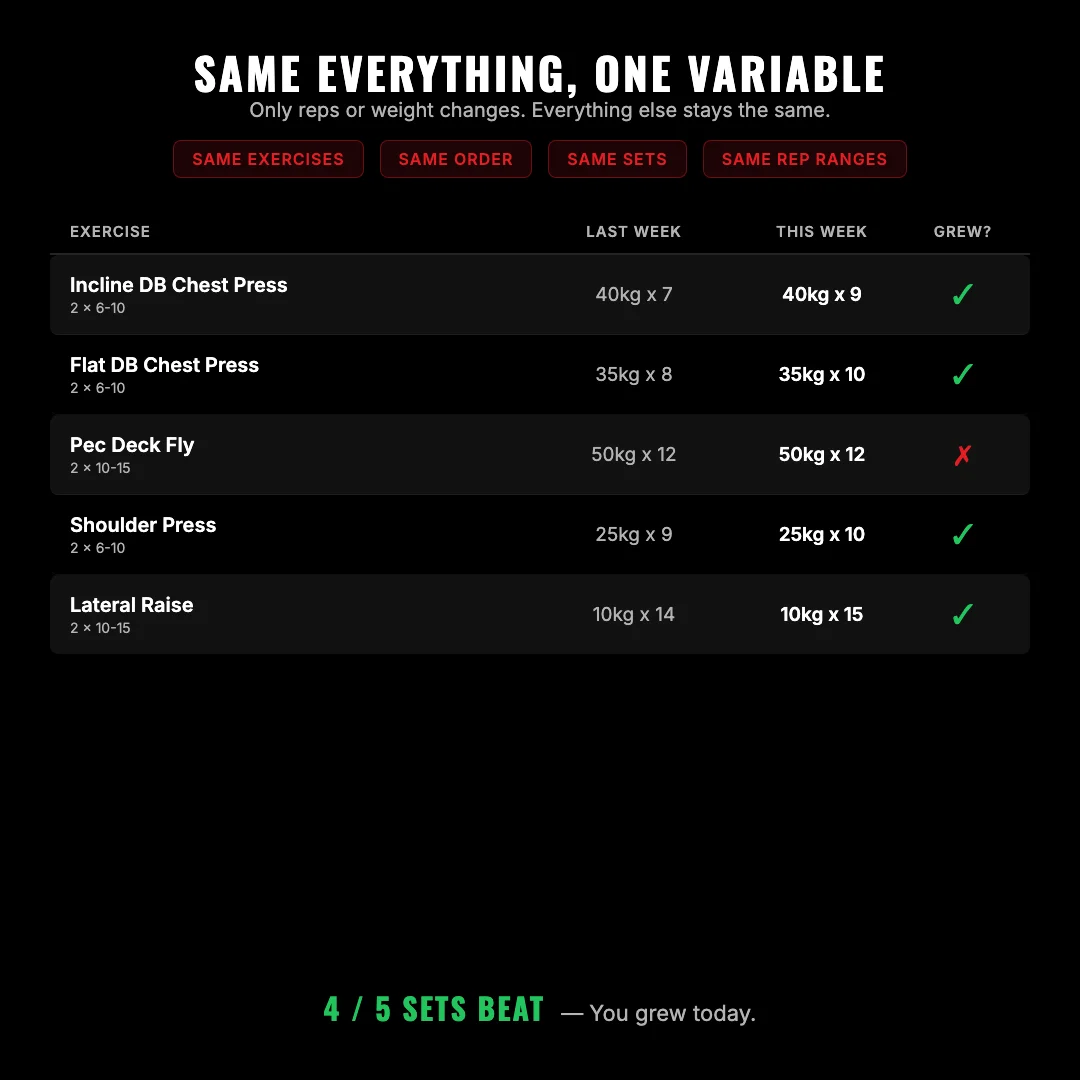
It Becomes A Yes Or No Question
When you standardise your training like this, every single session becomes dead simple. You walk in, you look at your numbers from last week, and you ask yourself one question: did I beat them?
- If yes — you grew. Good session.
- If no — you didn't. Now you know, and you can figure out why.
There's no guessing. There's no "I think that was a good workout." It's black and white. You either progressed or you didn't. That clarity is everything.
And when you're at rep eight and your body is screaming at you to stop, but you know you need ten to beat last week — that's when this system really kicks in. You know those two extra reps are the difference between growing and wasting your time.
Even Changing The Order Ruins It
This one trips blokes up all the time. They think "I'll keep the same exercises but just mix up the order." That ruins it too.
Say you did incline dumbbell press first last week when you were completely fresh. You hit 35s for 12 reps. This week you did it fourth — after flat bench, flyes, and cable crossovers. You're absolutely cooked by then. You hit 35s for 9 reps.
Did you get weaker? No. You were just more fatigued because the exercise was in a different position. But your numbers dropped, and now you have no idea if that's because you're actually weaker or because the order changed.
The reference point is gone. The data means nothing. Keep the order the same — every time.
Should I Mix Up My Workouts After A Few Weeks?
Here's another one we get all the time. Blokes have been on their program for six, eight, maybe twelve weeks and they start getting antsy. "Shouldn't my coach have changed my program by now?"
If you've been on the same program for 8-12 weeks and your coach hasn't changed it — that's a good thing. That means it's still working. There's a reason for the standardisation. Your coach isn't lazy. They're giving you the best possible environment to progress.
The only time you should change an exercise is if there's one you genuinely don't connect with. Maybe a movement doesn't feel right in a certain position, or you can't get the target muscle working no matter what you try. In that case — tell your coach, swap it out, and then work that new one up consistently. Don't swap again in two weeks.
What Consistency Actually Looks Like
Let me paint the picture of what proper training looks like:
- Week 1 — Incline DB Press: 30kg x 10, 10, 9
- Week 2 — Incline DB Press: 30kg x 10, 10, 10
- Week 3 — Incline DB Press: 32.5kg x 9, 9, 8
- Week 4 — Incline DB Press: 32.5kg x 10, 9, 9
See that? Same exercise. Same position in the workout. Same sets. You can see exactly what's happening. Reps are creeping up. Weight goes up when you're ready. There's no confusion. No guessing. Just clear, measurable progress.
Now compare that to the bloke who does a completely different chest workout every Monday. He's "training hard." He's getting a pump. But he has zero proof that he's actually growing. And in six months, he'll look exactly the same.
The Bottom Line
Stop trying to shock the muscle. It's not a thing. Your muscles don't get "confused" — they respond to progressive overload, and progressive overload requires a consistent reference point.
- Keep your exercises the same
- Keep the order the same
- Keep the sets and rep ranges the same
- Only change reps or weight — that's your one variable
- Track everything so you know if you're actually progressing
Standardise the process. Change one thing. Measure the result. That's how you build muscle. Everything else is just noise.
Sam Board
Founder & Head Coach at Built Body Transformations. 1,700+ clients coached.