The 3 Rules That Control Everything About Your Body
Every bloke who starts training thinks it's complicated. There's a million different opinions on what to eat, how to train, what supplements to take, when to do cardio — and none of it actually tells you what matters.
So let me simplify it for you.
Everything — and I mean everything — in body composition comes back to three rules. We call them The Core Three. Once you understand these, the noise disappears. You stop guessing. You start making decisions based on data, not some random thing you saw on Instagram.
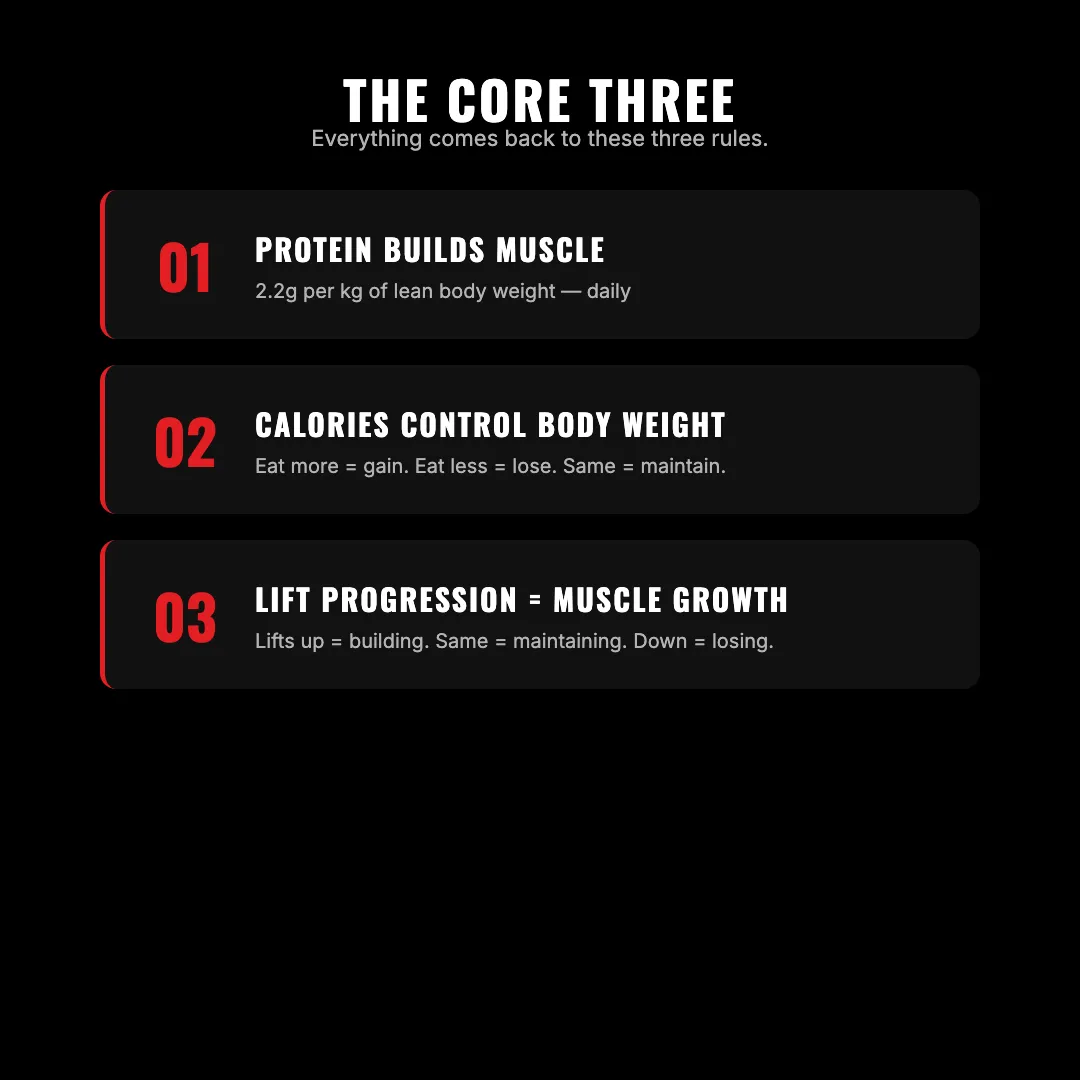
Let's break them down.
Rule 1: Protein Builds Muscle
This is the one most blokes think they understand but actually get wrong.
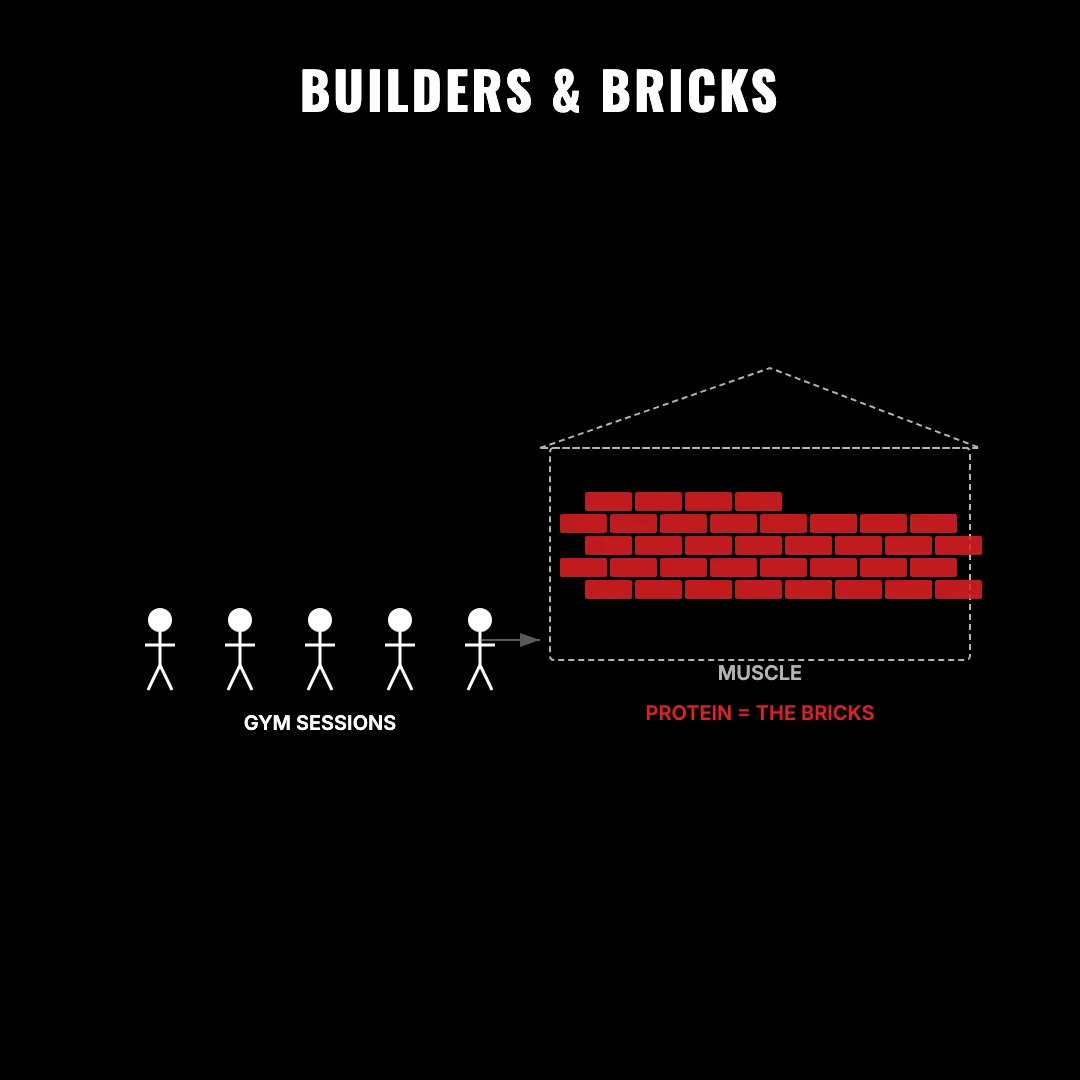
Here's the analogy we use: Builders and Bricks.
Every time you go to the gym and train a muscle, you're sending builders to a house. That's what a gym session does — it sends the signal to build. Great. But here's the problem.
If there's no bricks, the builders just sit there doing jack shit.
The bricks are protein. You can send as many builders as you want. You can train six days a week, smash every session, leave the gym crawling. But if you're not eating enough protein, nothing gets built. The signal was there. The materials weren't.
The target is 2.2 grams per kilogram of lean body weight, every single day. Doesn't matter if you're cutting, bulking, or maintaining. The protein target stays the same.
And notice I said lean body weight — not total body weight. A bloke who weighs 200 kilos but is carrying 150 kilos of fat doesn't need 440 grams of protein a day. That's insane. You calculate it off the muscle you're actually feeding, not the fat sitting on top.
Builders and Bricks: gym sessions send the builders. Protein provides the bricks. Hit 2.2g per kg of lean body weight every day — no exceptions.
Rule 2: Energy Balance Controls Body Weight
This one's simple. Brutally simple. And it doesn't care about your feelings.
Eat more calories than you burn — you gain weight. Eat less than you burn — you lose weight. Eat the same — you stay the same. That's it. That's the entire rule.
There's no food that "makes you fat." There's no magical combination of meals that bypasses thermodynamics. If you're in a caloric surplus, you gain. If you're in a deficit, you lose. End of story.
We control the "calories in" side through food tracking. You weigh and log what you eat so there's no guessing. And we control the "calories out" side through your step target and cardio.
Most blokes massively overestimate how much they're burning and massively underestimate how much they're eating. That's why they're stuck. Not because their metabolism is broken. Not because of their genetics. Because they're eating more than they think.
Energy balance is non-negotiable. Calories in vs calories out controls whether you gain, lose, or stay the same. Track your food. Hit your step target. Remove the guesswork.
Rule 3: Lift Progression Controls Muscle Growth
This is the one that blows most blokes' minds when they hear it for the first time.
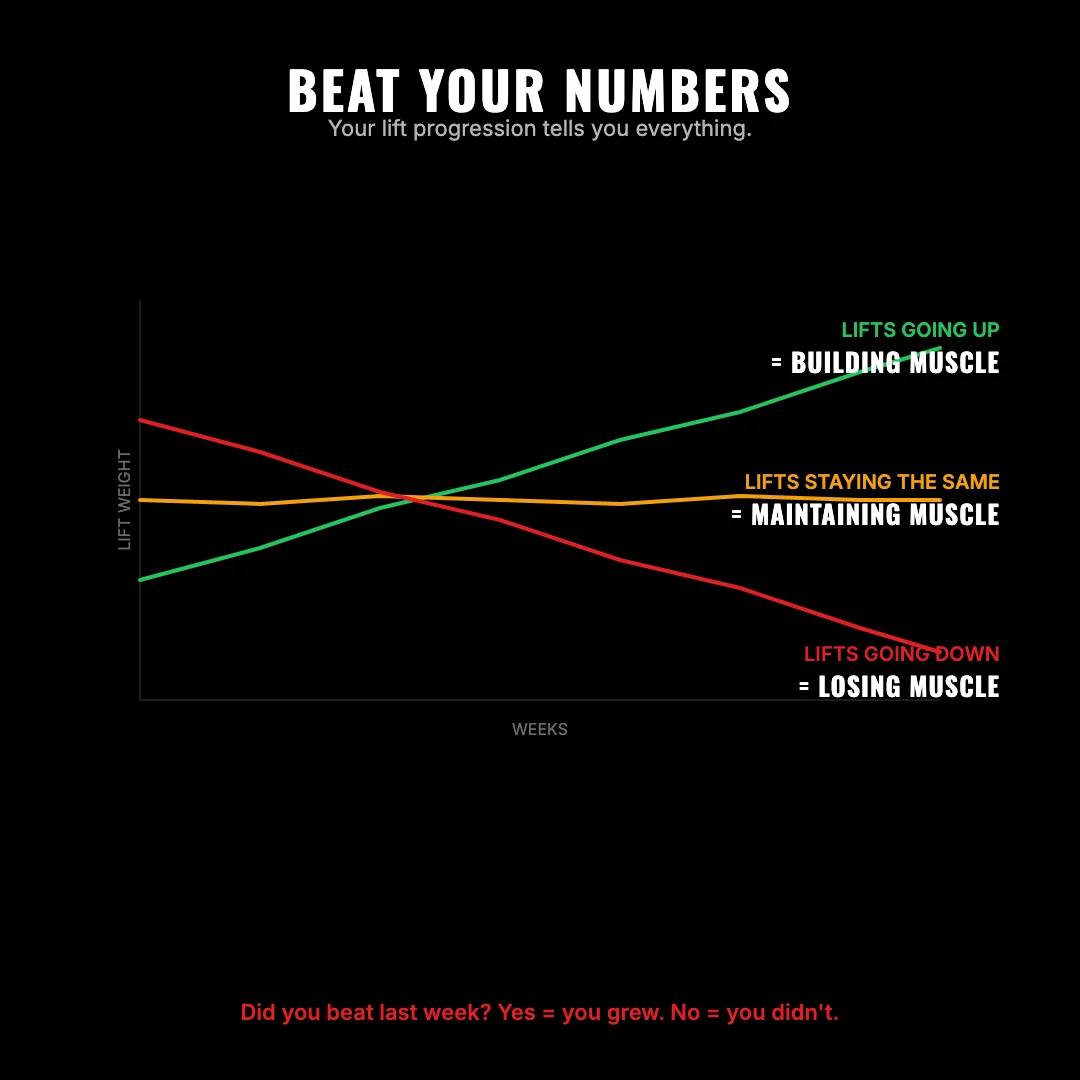
If your lifts are going up, you're building muscle. If your lifts stay the same, you're maintaining muscle. If your lifts are going down, you're losing muscle.
That's it. That's how you know.
Doesn't matter how hard you're training. Doesn't matter if you finish the session and you're absolutely cooked. Doesn't matter if you feel the pump, feel the burn, feel like you had the best session of your life. If your lifts are going down, you didn't build any muscle that session.
We call this principle Beat Your Numbers. Every session, the goal is to beat what you did last time. More weight, more reps, or both. If you're doing that week after week, you're growing. If you're not, something needs to change.
This is why random "muscle confusion" workouts don't work. You can't track progression if you're changing exercises every week. You can't beat your numbers if you never repeat the same movement long enough to improve at it.
Beat Your Numbers: if lifts go up, you're building. Same = maintaining. Going down = losing. Track every session and aim to beat what you did last time.
How The Core Three Work Together
These aren't three separate things. They're one system.
Protein gives your body the materials to build muscle. Energy balance controls whether the scale goes up, down, or stays put. Lift progression tells you whether actual muscle is being built, maintained, or lost.
When something isn't working — when you hit a plateau, when the scale won't budge, when you feel like you're spinning your wheels — you don't need to panic. You don't need to overhaul everything. You just come back to The Core Three and ask:
- Am I hitting my protein target?
- Is my energy balance set correctly for my goal?
- Are my lifts going up, staying the same, or going down?
The answer is always in one of those three things. Always.
This is what we mean when we say Data, Not Guesswork. We don't make decisions based on how you feel or what some bloke at the gym told you. We look at the numbers. Protein intake. Calorie balance. Lift progression. The data tells you exactly what's happening and exactly what to change.
Data, Not Guesswork: when you understand The Core Three, every decision becomes simple. Check the numbers. Adjust what needs adjusting. Keep moving forward.
These are the three rules that everything comes back to. When you understand them, it becomes a lot easier when you hit plateaus. A lot easier when things feel hard. Because you're not guessing — you know exactly what to do.
Simple doesn't mean easy. But at least now you know what the game actually is.

Sam Board
Founder & Head Coach at Built Body Transformations. 1,700+ clients coached.