Your Metabolism Isn't Broken — You're Just Not Tracking Properly
I hear this all the time. Blokes come to me and say: "I think my metabolism is broken."
They've been dieting for weeks. They've been "eating clean." The scale isn't moving. So the only logical explanation must be that their body has given up on them. Metabolism's cooked. Hormones are shot. Something must be medically wrong.
It's not. Your metabolism isn't broken. You're just not tracking properly. And I'm going to show you exactly how a tiny amount of untracked food can completely destroy your progress without you even realising it.
The Valley Of Despair
Let me explain this with real numbers, because once you see it, you can't unsee it.
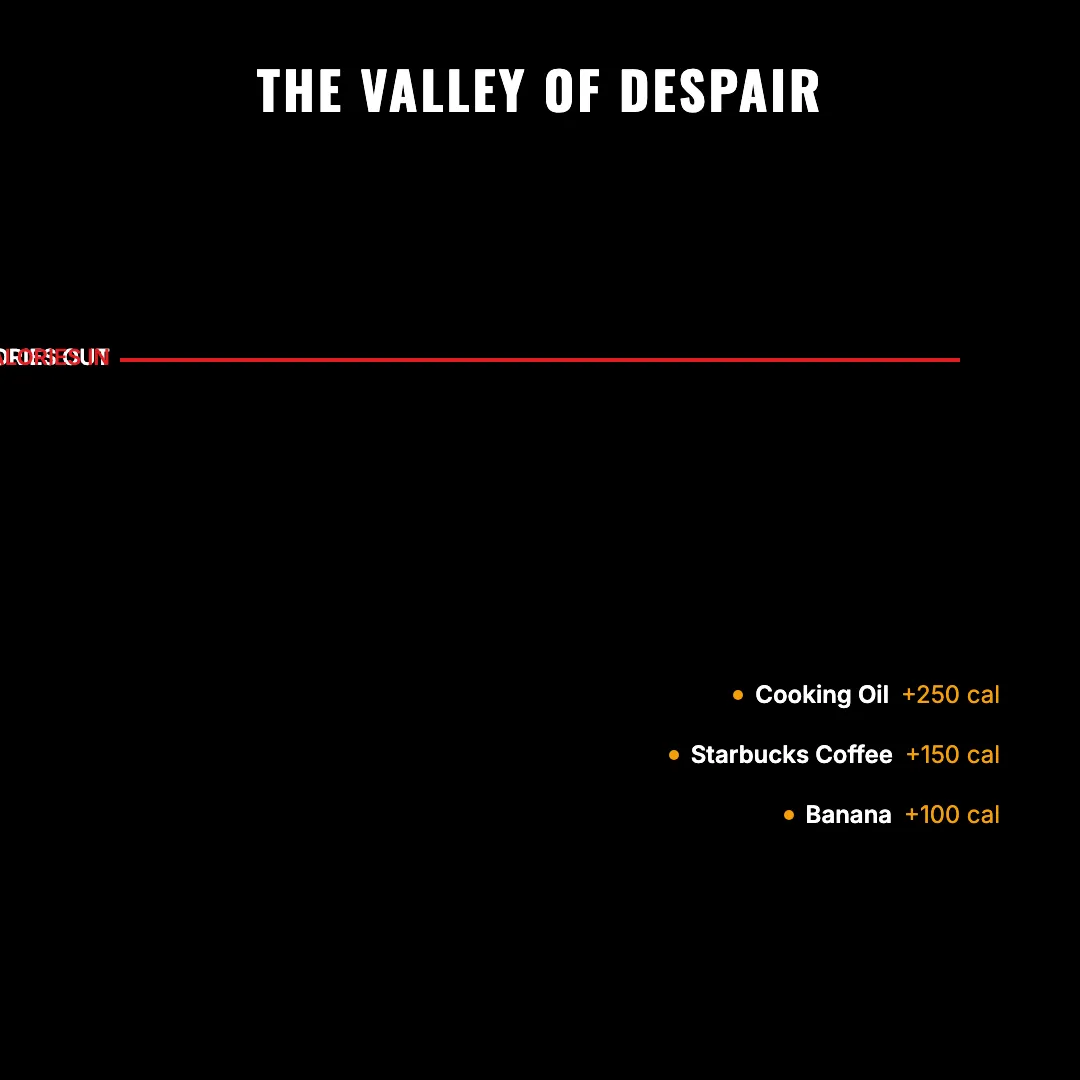
Say your maintenance calories are 2,500. That's what your body burns in a day just existing and moving around. To lose weight, your coach puts you at 2,000 calories. That's a 500 calorie deficit. That gap between 2,500 and 2,000 is what I call The Valley of Despair.
Why? Because it is way easier to close that gap than you think. And once you close it, you stop losing weight. Simple as that.
Here's how it happens on a "perfect" day:
- Two tablespoons of oil cooking your chicken and veg. You didn't weigh it, you just poured. That's 250 calories. You've just halved your deficit.
- An untracked coffee from the cafe on the way to work. Large latte, maybe a flavoured one. That's 150 calories. Your deficit is now 100 calories.
- A banana in the evening "because it's healthy." That's another 100 calories. You're back at maintenance.
Done. You've been "perfect" all day and you're not losing weight. Three things that feel like nothing — oil, coffee, banana — and your entire deficit is gone.
Now here's where it gets worse. You go back to your coach and say "I'm stuck." Coach looks at your food diary — everything looks fine on paper. So what do they do? They pull your calories down. Now you're at 1,800.
Great. Except now you're hungrier. So you pick at a bit more food. A handful of nuts here. A bite of the kids' dinner there. A slightly bigger serve of rice because you're starving. And guess what? You've closed the gap again.
Three to four weeks of this cycle and you're sitting there thinking: "My metabolism must be broken."
It's not broken. The Valley of Despair just got you.
The Valley of Despair: The gap between your maintenance and your target calories is tiny. A few untracked extras per day and it's gone — even when you think you've been perfect.
Everything Counts
This is the framework that fixes it. Everything counts.
The oil you cook with? Counts. The coffee? Counts. The banana? Counts. The handful of almonds you grabbed "because they're healthy"? Counts.
Healthy food still has calories. That's not a controversial statement — it's just maths. A banana is roughly 100 calories. Almonds are about 160 calories per small handful. Olive oil is the most calorie-dense thing in your kitchen at 120 calories per tablespoon.
None of these are bad foods. But if you've already hit your target for the day and you eat them on top, you've closed the gap. The food being "healthy" doesn't give it a free pass. It still has energy. Your body still counts it even if you don't.
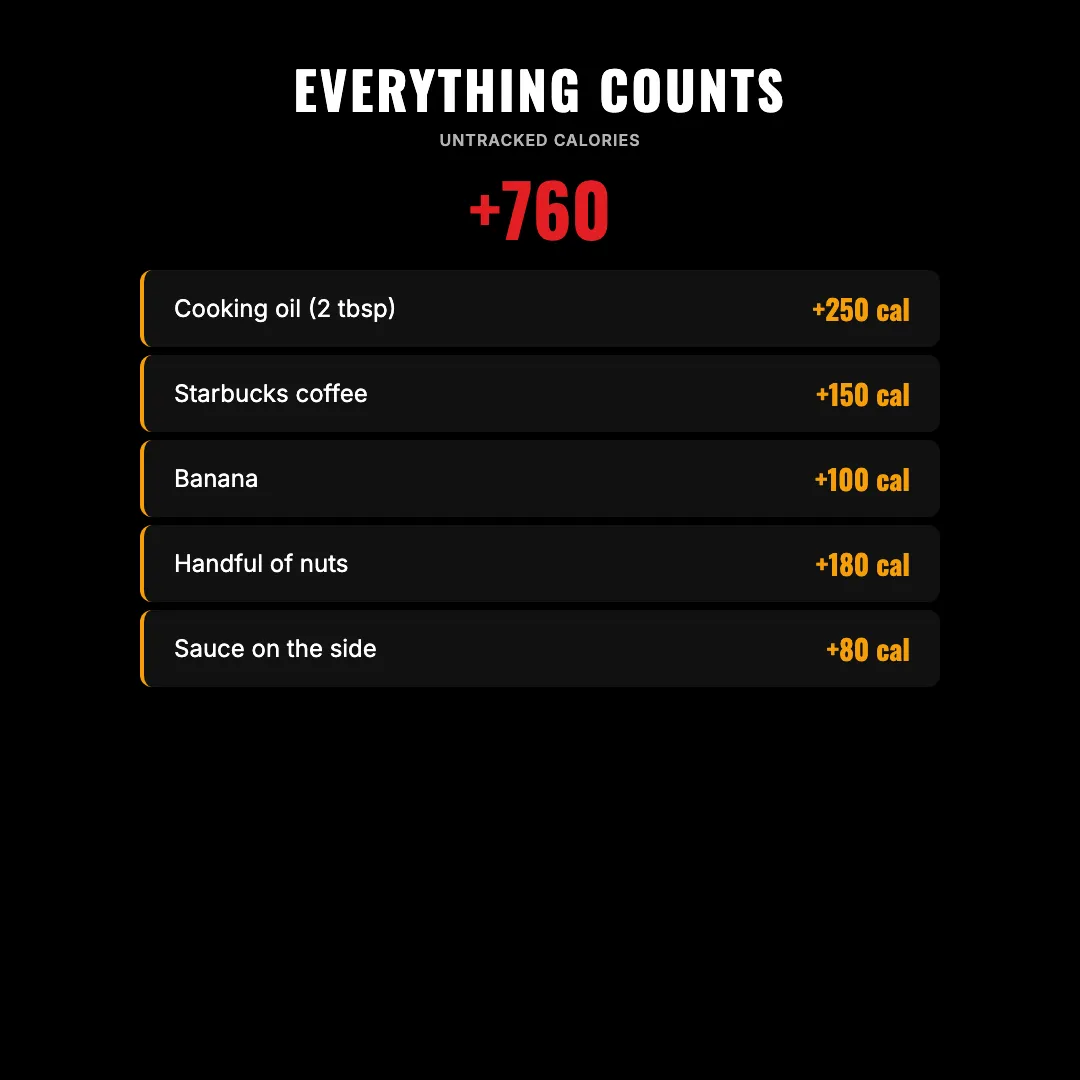
This is why blokes who "eat clean" but don't track properly can diet for months and go absolutely nowhere. They're eating good food. They're training hard. They feel like they're doing everything right. But the untracked extras add up to hundreds of calories per day, and that's enough to wipe out their entire deficit.
Everything Counts: If it goes in your mouth, it has calories. Oil, coffee, fruit, nuts — track it all or it will close your gap without you knowing.
The Broken Metabolism Myth
Now let's talk about the elephant in the room. Hormones. Thyroid. Metabolism. All the stuff people point to when calories in versus calories out "isn't working."
Here's the truth: those things affect how many calories you burn, but they don't break the rule.
If you have an underactive thyroid, your maintenance calories might be lower than someone else's. Fine. That means your target needs to be lower too. But the principle is exactly the same — eat less than you burn and you lose body fat. Always. No exceptions.
What hormones do cause is water fluctuations. Menstrual cycles, cortisol from stress, inflammation from training, poor sleep — all of these can cause your weight to spike 2-3 kilos overnight. That's water. Not body fat.
The trend still holds. If you're genuinely in a deficit, the trend line over weeks and months goes down. But if you're panicking about a single weigh-in and making decisions based on one bad number, you're going to make things worse.
The Broken Metabolism Myth: Your metabolism isn't broken. Hormones, thyroid, and stress affect your burn rate — but they don't break calories in versus calories out. The rule always holds.
Pull Them Hard
This one's more about coaching philosophy, but it matters if you're working with a coach or thinking about getting one.
Some coaches are scared to pull calories low enough. They see a 55 kilo person and think "I can't put them on 1,400 calories, that's too low." But here's the thing — it's relative. A 55 kilo person doesn't need as many calories as a 100 kilo person. Their maintenance might be 1,800. A 400 calorie deficit from there puts them at 1,400. That's not extreme. That's just maths.
You need to go where you need to go. That's the bottom line.
If the numbers need to come down, they need to come down. Tip-toeing around it because the number "looks low" on paper just means you spend longer in a diet phase, get more fatigued, lose more muscle, and get a worse result. Everyone's different. A number that's low for one person is maintenance for another.
The goal isn't to diet on the fewest calories possible. The goal is to get it done efficiently so you can get back to eating more and building. Dragging it out helps nobody.
Check In Every Week
This is the one that ties it all together. Check in every single week. Good week or bad week. Especially bad weeks.
Here's why missing data destroys progress.
Say your weight's been sitting at 92 kilos. One morning you wake up, step on the scale, and it says 95. You had a big meal last night, you're holding water, maybe you trained heavy legs the day before. It's water weight. Two days later you're back at 93.
Now — if your coach saw all three of those numbers, they know exactly what happened. Water spike. No big deal. Stay the course.
But if you skipped your check-in that week because the number scared you, and the next week you come in at 93 — your coach thinks you've gained a kilo from 92. They might pull your calories down when they didn't need to. They might change your plan based on incomplete information.
Missing data leads to bad decisions. Every data point matters — the good ones, the bad ones, and especially the ones that look scary.
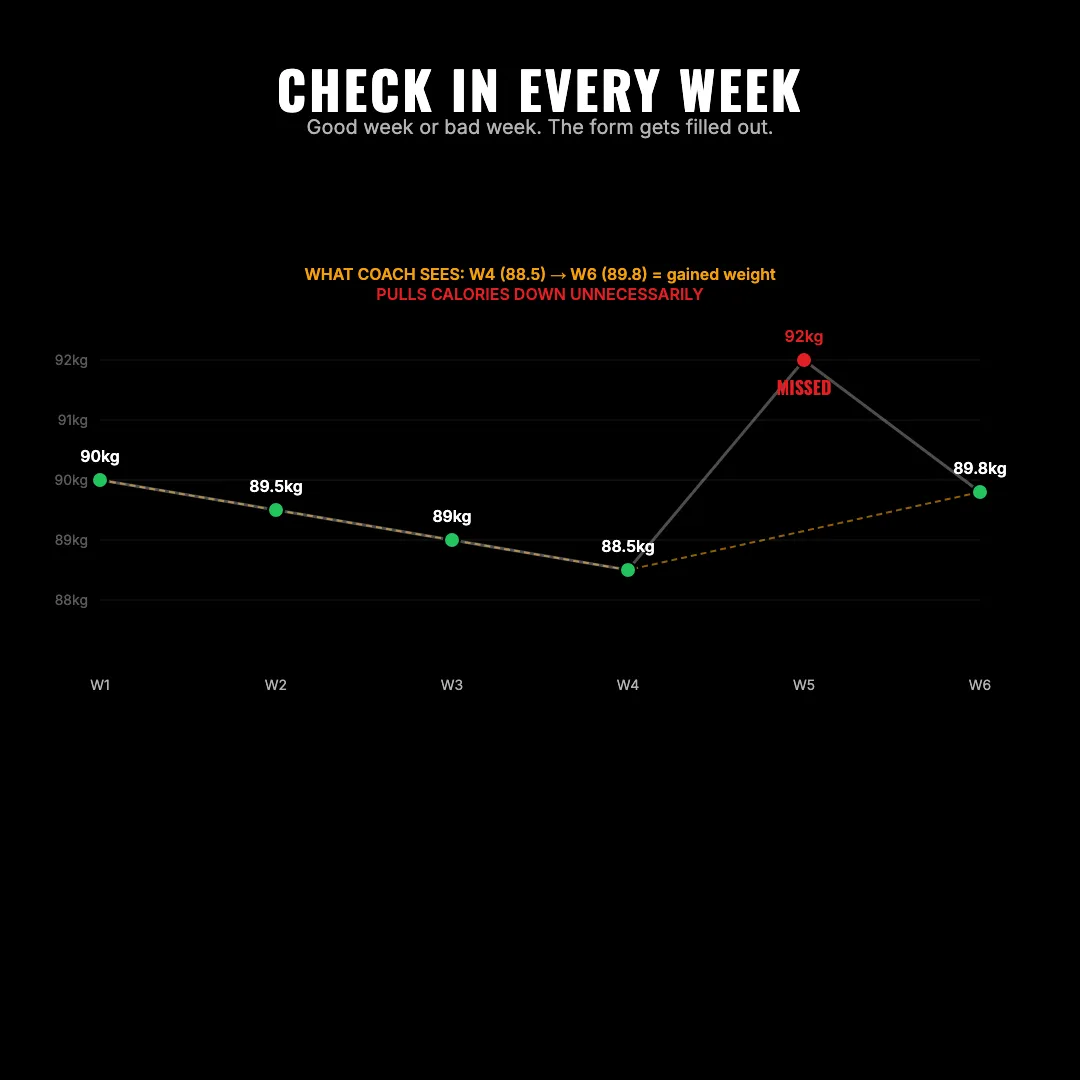
Your coach can't help you if they can't see the full picture. A weight spike with context is nothing. A weight spike without context looks like you're going backwards. Don't hide the bad weeks — they're the most important ones.
Check In Every Week: Good week or bad week — check in. Missing data means bad decisions. Every number matters, especially the scary ones.
The Bottom Line
Your metabolism isn't broken. The rules haven't changed. Calories in versus calories out works the same way it always has.
If you've stalled, the answer is almost always in the tracking. The oil. The coffee. The "healthy" snacks. The extras that feel like nothing but add up to everything.
- Track everything. If it goes in your mouth, it counts.
- Don't fear the numbers. If calories need to go lower, go lower.
- Check in every week. Your coach needs every data point to make the right call.
- Stop blaming your metabolism. Start tracking properly and the scale will move.
The blokes who get the best results aren't the ones with the fastest metabolisms. They're the ones who track accurately and check in consistently. That's it. No secrets. No hacks. Just do the work properly.

Sam Board
Founder & Head Coach at Built Body Transformations. 1,700+ clients coached.